Skip to content
View in the app

A better way to browse. Learn more.

Wanderers Ways. Neil Thompson 1961-2021

A full-screen app on your home screen with push notifications, badges and more.

To install this app on iOS and iPadOS
  1. Tap the Share icon in Safari
  2. Scroll the menu and tap Add to Home Screen.
  3. Tap Add in the top-right corner.
To install this app on Android
  1. Tap the 3-dot menu (⋮) in the top-right corner of the browser.
  2. Tap Add to Home screen or Install app.
  3. Confirm by tapping Install.

Donald Dead Cat On Is Head Trump

is that it now game over no chance of POTUS


Rayguns out

  • Replies 22.1k
  • Views 1.3m
  • Created
  • Last Reply

Top Posters In This Topic

Most Popular Posts

Posted Images

Featured Replies

50 minutes ago, Dimron said:

In the early stages I supported the disruption... just like in this country the status quo is too comforatble and elite.

BUT... he has gone far too far, bordering on a fascist dictatorship now and his public are blinded.

Mid terms soon...

If what's being reported is true, he's going to get royally stuffed in them......of course, he'll claim voting fraud or something

1 hour ago, Sweep said:

If what's being reported is true, he's going to get royally stuffed in them......of course, he'll claim voting fraud or something

Pregnant chads ?

A blistering attack on Trumps war from Antony Blinken, former US Secretary of State (Rubio's equivalent)

I highly recommend that you read it all.

Thoughts on the “Ceasefire” with Iran: President Trump should share the ceasefire agreement with the American people.  They deserve to see it and draw their own conclusions about the results of the president’s war. Just as they should have been informed before he launched it. From what’s been reported, it’s a bad deal to end a misguided war of President Trump’s choosing. The only thing worse would be to continue the war that has proven so costly in lives lost — including U.S. service members — and taxpayer dollars spent without making the American people safer or their lives better. By President Trump’s own terms, the war is a failure. The Iranian regime is intact and its military wing more empowered, while the Iranian people are more impoverished, repressed and desperate. Iran apparently retains a significant supply of missiles and drones and the productive capacity to make more. It has renewed links to lethal proxies in Lebanon, Iraq, Yemen and elsewhere. The ceasefire agreement seems to be silent about these issues The attempt to “re-obliterate” Iran’s nuclear program — which President Trump claimed to have wiped out last year — failed. Iran still has the highly enriched uranium it had produced before the war started, along with centrifuges to spin the uranium into weapons-grade material. Maybe that will be addressed in the negotiations that are supposed to start this week. But at what price in terms of sanctions relief and assets unfrozen? At best, we’ll get back to something that looks like the JCPOA — the nuclear deal negotiated by President Obama without going to war that put Iran’s nuclear program in a box. President Trump tore up the JCPOA in 2018 and then failed to replace it. There’s reason to doubt we will come away with anything as strong as the JCPOA — which took two years to negotiate in partnership with all the major powers — in 60 days, playing a far weaker hand. And by the way, if the president tries to claim credit for Iran renouncing nuclear weapons as part of any agreement, look no further than the very first paragraph of the JCPOA, which contains the same pledge. The only “achievement” of the ceasefire is the likely re-opening the Strait of Hormuz — which was open before the war started. And we will apparently pay Iran to do so, in the form of waivers for the export of Iranian crude oil. Iran has now demonstrated the capacity to stop or slow the passage of oil, natural gas, fertilizer and other critical products upon which so much of the world depend. Going forward, it will almost certainly find ways to collect “fees” for safe passage that will help entrench the regime. Don’t expect a return to normal any time soon, if at all. Crude oil prices will drop from the record highs they reached — but they’re unlikely to fall to pre-war levels. We will all pay for a sustained inflationary effect. It will take time to restart oil and gas production, repair infrastructure, refill dangerously depleted stockpiles, clear mines, and restore confidence. Just as it will take a lot of time to replenish our own supply of offensive and defensive missiles, to the detriment of our deterrent in other parts of the world. Maybe the only positive development is the world’s renewed focus on renewable energy as a way to break the stranglehold of the Strait. But China will be the big winner as the world’s leader in wind, solar, EV’s and batteries — further expanding its influence — while the Trump administration is paying wind farms to shut down and gutting incentives to make us more competitive in EVs. (I just returned from Norway, where more than 90 percent of the new cars sold last year were full EV’s. Norway may be ahead of the curve, but we’re driving right off the road). Meanwhile, the administration achieved a terrible trifecta of alienating our partners in Europe (insulted and threatened for two years, not consulted on the war and then lambasted for not helping bail us out), Asia (which bore the greatest impact of high energy prices and rising scarcity) and the Middle East (the primary target of Iranian retaliation), while diminishing our standing and credibility everywhere. Most of all, President Trump’s war of choice has failed the ultimate foreign policy test: it has failed to make the American people better off. At a time when more and more American families are struggling to make ends meet, this war has made filling everything from the gas tank to the grocery cart to medical prescriptions harder and more expensive. We should all be glad the war is over — for now. No doubt President Trump will claim credit for ending it. But that’s like an arsonist boasting about putting out a fire he started after half the house has been burnt down.


Bolty will be along to tell us all what a fantastic deal it is and that Trump has only done it to upset lefty wetwipes and something about coming over the hill

A few more observations about the Memorandum of Understanding

Despite the success of negotiating this Memorandum of Understanding (MOU) there are some serious questions still to be resolved.

Most crucial of all is the nuclear file. The coming 60 days is a very short period in which to thrash out just how Iran’s nuclear programme is going to be monitored to prevent any chance it could be secretly working on a nuclear weapon. It took ten times that length of time to reach the 2015 JCPOA deal that President Trump abandoned in his first term of office.

When the mandated 60-day period of free traffic through the Strait is up then there remains the risk that Iran will try to impose a new paradigm on maritime traffic, charging ‘fees’ rather than ‘a toll’, which are effectively the same thing.

Then there is the money challenge. Under the MOU, Iran is due to get a US $300bn fund for reconstruction, largely financed by the same Gulf Arab states it’s been attacking. Both they and the US will want to ensure that none of this money ends up funding the IRGC’s ballistic missile or drone programmes.

Frank Gardner
Security correspondent

If you look at the black and white of the text, Iran “reaffirms” that it will not acquire a nuclear weapon - but that’s what it's been saying for years. It was in the 2015 nuclear accord President Trump pulled out of in his first term, declaring he could do a much better deal.

In this 14-point framework, the only hint of the shape of Iran's nuclear programme is the mention of “down- blending” Iran's 440 kg of uranium, enriched to some 60%, dangerously close to weapons-grade.

It’s a concession Iran made in the February 2026 talks in Geneva - two days before this war. There’s no mention of President Trump’s repeated demand that what he calls 'nuclear dust' is shipped to the United States.

If Iran wants a web of crippling sanctions lifted, and assets unfrozen, it needs to make concessions on dismantling its nuclear programme.

But what it already has in this framework is immediate waivers on exporting its crude oil, its petroleum products, and a $300bn “reconstruction fund” being put in place.

This morning Iran must be feeling quite confident and quite pleased about this deal.

Lyse Doucet
Chief international correspondent

20 minutes ago, Spider said:

Bolty will be along to tell us all what a fantastic deal it is and that Trump has only done it to upset lefty wetwipes and something about coming over the hill

followed by a count down of how many more days he has left in office, he loves that one for some reason

Don’t know about everyone else but I can’t wait for Trump successes to be replicated over here once we’ve got Nige, our own great disrupter at the helm. We‘ll be taking back control, draining the swamp and errrr, lots of other things. Can’t wait.

Edited by Bertie

Trump seems to be very 'shouty' about his success...

Image

Just for balance...

Expert says nuclear aspect of deal 'a real question mark'

Joel Rayburn, who was the senior director for Iran, Iraq, Syria and Lebanon on the National Security Council during Trump's first administration, says there could be several "hiccups" on the way to a full peace deal.

He says Iran's negotiating tactic is often to "move the goal posts and stuff more concessions in in the 11th hour" - especially on issues where the two sides are far apart, like nuclear weapons.

But for now, Rayburn says both sides are focused on reopening the strait, so he's "not surprised" by the lack of detail on other, longer-term issues.

Independent nuclear expert Patricia Lewis echoes this, saying the nuclear aspect of the deal is "a real question mark" at the moment - as it seems Iran is "getting a lot" for "very little in return".

From the BBC...... 🤣

Meanwhile, Trump hits out at critics, saying "fools" who believe he hasn't been "tough enough" on Iran are either "jealous, bad people, or stupid"

I think I'll choose 'bad person's please Donald. You absolute massive fanny! 🤣

32 minutes ago, Sluffy said:

Trump seems to be very 'shouty' about his success...

Image

Just for balance...

Expert says nuclear aspect of deal 'a real question mark'

Joel Rayburn, who was the senior director for Iran, Iraq, Syria and Lebanon on the National Security Council during Trump's first administration, says there could be several "hiccups" on the way to a full peace deal.

He says Iran's negotiating tactic is often to "move the goal posts and stuff more concessions in in the 11th hour" - especially on issues where the two sides are far apart, like nuclear weapons.

But for now, Rayburn says both sides are focused on reopening the strait, so he's "not surprised" by the lack of detail on other, longer-term issues.

Independent nuclear expert Patricia Lewis echoes this, saying the nuclear aspect of the deal is "a real question mark" at the moment - as it seems Iran is "getting a lot" for "very little in return".

I like how he's put 'AFFORDABILITY!' in brackets just in case we didn't understand his technical language 🤣

Thanks Big Donald 😁👏👏👏

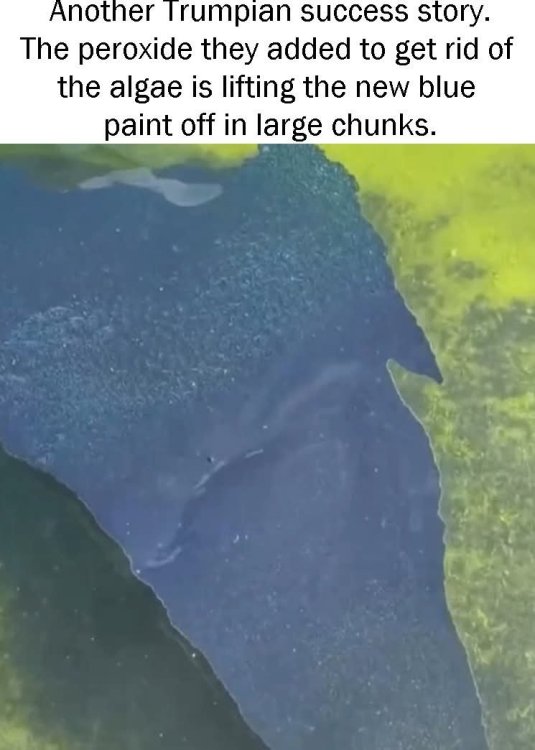
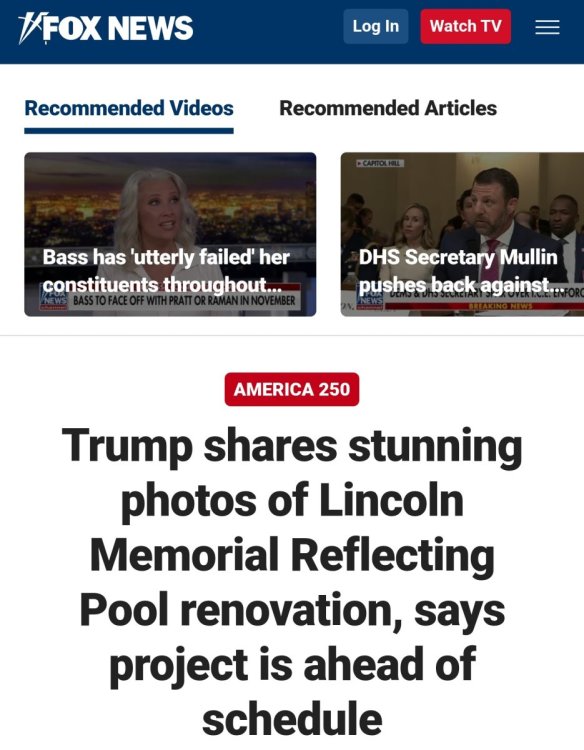
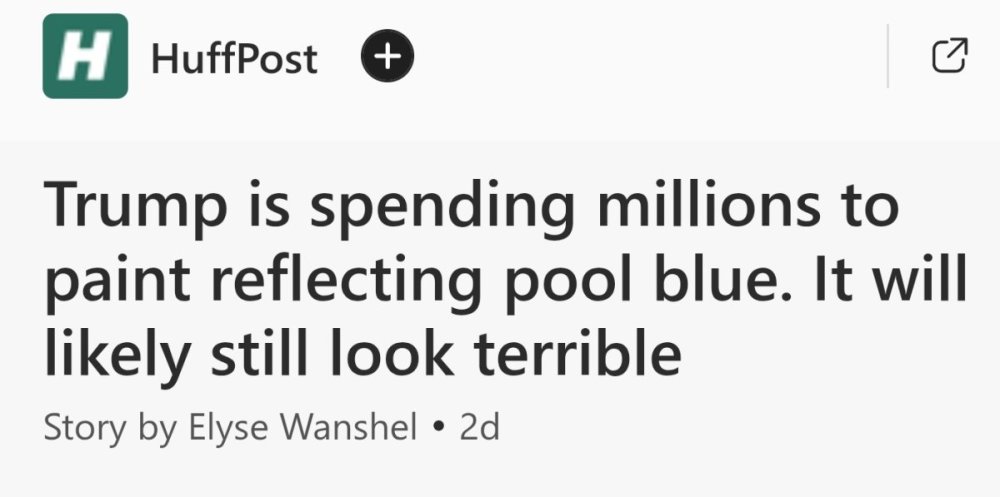
At least Trump's Reflecting Pool has been a great success.

On the 5th June this

06/05/26 - The work done to the Reflecting Pool was not a simple paint job,  which is why I spent the last few months prattling on endlessly about  painting it blue. : r/trumptweets

On the 16th June this...

Trump administration blames Obama after 'blue' Reflecting Pool turns green  after $14M refurb | The Independent

Fresh off a multimillion-dollar renovation ordered by President Donald Trump, the Lincoln Memorial Reflecting Pool is now a sea of green.

The president had wanted a pool filled with clear water and a bottom painted “American Flag Blue,” the color of a commercial-grade swimming pool liner he had added to the granite pool to address leaks.

Instead, dark green clumps of algae sat Tuesday morning on a lighter green layer of algae that’s blanketed the water.

Algae started forming in the pool last week, within days of the renovation’s completion. An Interior Department spokesperson Friday said the agency would remove the algae and use “nanobubblers” to keep it clean. But the algae has quickly spread.

Brooks Barrett, who studies marine plant life at the Smithsonian Institution, said there’s “no quick fix” to the algae bloom in the pool.

“The reflecting pool is perfect for algae. If you were trying to biofarm algae, this would be the way to go. It’s warm, it’s stagnant, it’s perfect,” he said.

Kym Hall, the former regional director for (National Parks Service) NPS’ capitol region, said Trump’s fix ignored the larger, more expensive, problems that the pool faced. She noted that the filtration system and piping need renovations. “I’m not sure how this administration thought they were going to somehow overcome a long-standing challenge of keeping [the pool] clear (not to mention wildlife contributing waste to the water) by painting it,” she said.

Hall said that the pipes and filtration system hold about 500,000 gallons of water of the roughly 4-million-gallon system, which is fed from the water in the Tidal Basin. NPS treats the water with ozone, which helps kill bacteria and depress algae growth.

“Trying to keep the algae at bay is a huge battle. So, they clean it each year and keep trying to keep it clean,” she said. “If this problem could have been easily solved or cheaply solved, somebody would have freaking done it.”

Source - Politico

😃

1 hour ago, frank_spencer said:

FB_IMG_1781803371215.jpg

How long until he puts it down to sabotage?

6 minutes ago, Sweep said:

How long until he puts it down to sabotage?

I think this may be fake news as I can't seem to find any other source to confirm the story, meanwhile...

Trump made deal 'out of desperation'

Here is the full message from Iran's Supreme Leader Mojtaba Khamenei published on Iranian media.

"As you have been informed, a memorandum of understanding was signed between the presidents of Iran and the United States of America.

"In the course of reaching this stage, the officials in charge, out of sincere concern and goodwill, made extensive efforts—and of course, it was the American president who, out of desperation, used all kinds of leverage to bring this about.

"I, as a matter of principle, held a different view; however, out of the commitment that the esteemed [Iranian] president—as the head of the Supreme National Security Council—gave to me on his own behalf and on behalf of the other members regarding the safeguarding of the rights of the Iranian nation and the Resistance Front, and his explicit acceptance of that responsibility, I granted my permission.

"He [Pezeshkian] also explicitly stated that if the American side seeks to make excessive demands, they will not submit to them. From this moment on, we—that is, you, the proud nation, and this humble servant—will await the realization of the aforementioned conditions.

"However, it's self-evident that the in-person negotiations in the future will not mean acceptance of the enemy's position. We hope the blessed prayers of our Master (may God hasten his noble reappearance) will bring all kinds of victories & triumphs to honorable Iranian nation."

How does Trump’s MOU with Iran compare with Obama’s nuclear pact?

By Federica Marsi

Published On 18 Jun 202618 Jun 2026

A memorandum of understanding (MOU) for ending the US-Iran war has been electronically signed near the French capital, Paris, after weeks of US President Donald Trump’s repeated claims that an agreement was close. The 14-point framework signed on Wednesday sees Iran commit to refrain from procuring or developing nuclear weapons in exchange for sanctions relief, a $300bn reconstruction plan and the restarting of maritime traffic in the Strait of Hormuz.

In comments made on the sidelines of the G7 meeting in France on Wednesday, Trump hailed the deal with Iran as being better than the deal brokered by former US President Barack Obama in 2015, known as the Joint Comprehensive Plan of Action (JCPOA), which Trump withdrew from during his first term in 2018. However, analysts warn it is too soon to determine whether the MOU, which triggers a 60-day negotiation period, will result in a comprehensive deal significantly different from the 18-page Obama-era document, which took several years to negotiate and included the input of nuclear experts.

Aniseh Bassiri Tabrizi, associate fellow at Chatham House, in the UK, told Al Jazeera it would not be “fair” to compare the two at this stage, as the MOU focuses on extending the ceasefire rather than tackling Iran’s nuclear programme in detail. Shahram Akbarzadeh, director of the Middle East Studies Forum at Deakin University in Melbourne, Australia, said the MOU “does not address any issue of substance.” “It simply leaves all questions regarding Iran’s nuclear programme and enrichment to be negotiated between the United States and Iran,” he said.

Here’s how the little we do know about the agreement compares to the provisions of the JCPOA.

Curbing Iran’s nuclear and weapons programmes

The agreement pushes discussions about Iran’s nuclear programme into the 60-day negotiation period, but states that Tehran “shall not procure or develop nuclear weapons”. Both sides also commit to “resolve the disposition of stockpiled enriched material pursuant to a mechanism that will be mutually agreed upon”.

The JCPOA included the same commitment not to develop nuclear weapons from Iran. It did allow Iran to enrich uranium up to 3.67 percent for 15 years – enough for developing a nuclear power programme, but well below the 90 percent needed to produce nuclear weapons. The memorandum does not mention whether Iran will be allowed to enrich uranium at all or for how long.

Up until Trump withdrew the US from the JCPOA, independent inspectors confirmed that Iran had stuck to the specified limits. Akbarzadeh pointed out that the Iranian pledge not to develop nuclear weapons included in the MOU is “not a new point, or a new commitment”. “Iran has consistently reiterated that it does not pursue the atomic bomb,” the analyst said.

Additionally, while the JCPOA was an international agreement including China, Russia, the UK and Germany “with detailed measures to limit uranium enrichment and an intrusive monitoring regime to ensure Iranian compliance”, the memorandum is a shaky bilateral agreement between parties who have little trust in each other, Akbarzadeh said. While the JCPOA had very specific terms for sanctions in the event of non-compliance, no such details are in the memorandum. The JCPOA did not place limits on Iran’s conventional military, including its supply of ballistic missiles – something that the US had demanded before the start of the war, but which is similarly not addressed by the MOU.

Frederic Schneider, non-resident senior fellow at the Middle East Council on Global Affairs, also noted that, in itself, Iran’s commitment to refrain from developing nuclear weapons was no significant gain for the US. “A Trump deal achieving this would be merely preserving the status quo,” Schneider told Al Jazeera, adding that intelligence agencies, including the CIA, had already concluded before the US-Iran 12-day war in June 2025 that Tehran was not actively developing nuclear weapons. “It is doubtful that any Trump deal will achieve any improvements on the JCPOA on that matter,” he concluded.

Sanctions relief and investment

The memorandum states that the US commits “to terminate all types of sanctions against the Islamic Republic of Iran” and to develop with regional partners “a definitive, mutually agreed plan with at least $300 billion for the reconstruction and economic development” of the country. While the JCPOA made gradual sanctions relief conditional on Iran’s compliance with curbs on its nuclear programme, the wording of this memorandum states that the waiver will take effect on “an agreed-upon schedule as part of the final deal”.

Ali Alavi, lecturer in Middle Eastern and Iranian studies at SOAS University of London, in the UK, said the removal of sanctions is a priority for Tehran, made more urgent by the extensive economic damage inflicted by weeks of war. While the JCPOA did not include funding for economic development, which was never on the table during previous negotiations, the $300bn investment fund pledged for reconstruction in Iran through regional partners is a massive payday which could lift Tehran out of its isolation.

Alavi said that while Iran would reap economic benefits – an outcome that Trump had criticised in the JCPOA – “the whole region would be better off”. By furthering economic integration between Iran and the Gulf Cooperation Countries (GCC), the reconstruction fund would help ease tensions in the region. The memorandum also states Washington’s commitment to make frozen assets “fully available” for Iran.

Trump had criticised the JCPOA for allowing Iran access to some restricted funds and cited this as a major reason for pulling out. In an apparent U-turn on this point on Wednesday, however, he stated these funds were “Iran’s money”. “At a certain point in time, I guess we’re going to have to give it back,” he told reporters on the sidelines of the G7 summit. Schneider, at the Middle East Council on Global Affairs, noted that this commitment is more symbolic than practical. “The US themselves do not hold many Iranian assets directly,” the analyst said. “The majority of these funds are stranded trade revenue, with the biggest tranches being in China and Iraq.” Therefore, “any promises to ‘unfreeze’ assets are not in the Trump administration’s jurisdiction”, he added.

The Strait of Hormuz

While this was never on the agenda for the purposes of the JCPOA, it has become a vital piece of leverage for Iran in negotiations this time around. Iran shuttered the vital maritime chokepoint early into the conflict that began on February 28, blocking roughly one-fifth of the world’s oil and liquefied natural gas supplies and sending shockwaves through global energy markets. The price of oil surged, and many countries faced severe energy shortages. The US began a corresponding naval blockade of Iranian ports a few weeks later. Trump was jubilant when he announced a preliminary deal with Iran on Sunday, saying, “Ships of the World, start your engines. Let the oil flow!” The memorandum states that the US would begin the removal of its blockade “immediately” upon the signing of the 14-point document and “fully end the naval blockade within 30 days”. It also states that Iran “will conduct dialogue with the Sultanate of Oman to define the future administration and maritime services and the Strait of Hormuz”. The phrasing leaves the door open for the two countries to negotiate future arrangements of the waterway, which had been free of charge before the war.

Under international law, tolls may not be charged through natural straits such as Hormuz. However, Iran has insisted that it is permissible for adjacent states to charge fees for “services” rendered to shipping passing through, such as insurance or docking, which are permitted under maritime law.

Alavi, at SOAS, said Iran has effectively managed to establish a “new order” in the Middle East by asserting control over the waterway. “Iran has more leverage now than it had during the JCPOA [negotiations],” he said.

“Trump could not bear the [economic] pressure” generated by the closure of the Strait of Hormuz and “gave much more than the JCPOA gave to Iran”, he added.

Iran’s proxies and the Lebanon war

Neither the MOU nor the JCPOA explicitly addressed Iranian-supported armed groups in the region, such as Hezbollah in Lebanon, Hamas in Gaza and the Houthis in Yemen. But the memorandum declares “the immediate and permanent termination of military operations on all fronts, including in Lebanon”. It does not mention Israel, which launched the war on Iran alongside the US in February, or Hezbollah, however.

Israeli Prime Minister Benjamin Netanyahu has pledged to continue Israel’s occupation of southern Lebanon despite the announcement of a US-Iran deal that links to those hostilities. “The Trump deal, as it is currently shaping up, does not demand concessions regarding Iranian regional allies and, in contrast, includes concessions by the US side to contain Israel in the war it is waging on Lebanon,” Schneider said.

“The JCPOA was very narrow and technical on purpose to avoid getting entangled in the complexities of other issues, and, as such, did not include Iranian allies, which was a topic relegated to the UN Security Council.” According to Bassiri Tabrizi at Chatham House, what would make Trump’s deal better than the JCPOA would be if it “doesn’t push Iran towards the perception of a continued … deterrence posture through the nuclear programme and through [its] proxies.” What is needed now, he said, is “a deal that attracts Iran so much economically and … that slowly and gradually brings Iran out of the perception of vulnerability [and] builds on mutual trust.” The next 60 days will determine if that is possible.

Sources - Aljazeera

11 hours ago, Sweep said:

and yet at least one person on here think's he's a master disruptor, and this is all part of some incredible masterplan......although to be fair, even he's gone quiet on Trump of late. Maybe, he's realised that, and not for the first time, he's backed the wrong horse as usual. 🙂

Same with Gyokeres. He’s persisting, bless him.

Seems Vance is being used again as Trumps 'attack dog' (I would normally post up the definition of 'attack dog' but seems I've been upsetting too many folk for doing so)

Anyway...

Trump's decision to end the war with Iran has raised criticism from some in the US, including Republicans dismayed by the terms of the deal - especially the provision of a reconstruction fund for Iran.

Republican Senator Bill Cassidy described the agreement as the "worst foreign policy blunder in decades". "Iran's nuclear ambitions were not curbed, and they have learned that threatening the Strait of Hormuz works," he said.

Vance defended the deal on Thursday, saying that Iran will not receive money or sanctions relief unless it meets obligations set out in the agreement. He said the deal, known as the Memorandum of Understanding (MoU), requires Iran to destroy its stockpile of enriched uranium, and show it will not fund proxy groups in the region.

Vance also castigated members of Israeli Prime Minister Benjamin Netanyahu's cabinet for criticising the Iran deal, saying they should "wake up and smell the reality." "If I was in the cabinet of the Israeli government, I might not be attacking the only powerful ally that I have anywhere left in the entire world," the vice-president told reporters.

In an interview with the New York Times also published on Thursday, Vance named Israel's national security minister Itamar Ben Gvir and finance minister Bezalel Smotrich as critics of the deal. He said: "I guess my response to them would be - what is your exact proposal? You're a country of nine million people. You can't just kill your way out of solving every single national security problem that you have."

18 minutes ago, Sluffy said:

Seems Vance is being used again as Trumps 'attack dog' (I would normally post up the definition of 'attack dog' but seems I've been upsetting too many folk for doing so)

Anyway...

Trump's decision to end the war with Iran has raised criticism from some in the US, including Republicans dismayed by the terms of the deal - especially the provision of a reconstruction fund for Iran.

Republican Senator Bill Cassidy described the agreement as the "worst foreign policy blunder in decades". "Iran's nuclear ambitions were not curbed, and they have learned that threatening the Strait of Hormuz works," he said.

Vance defended the deal on Thursday, saying that Iran will not receive money or sanctions relief unless it meets obligations set out in the agreement. He said the deal, known as the Memorandum of Understanding (MoU), requires Iran to destroy its stockpile of enriched uranium, and show it will not fund proxy groups in the region.

Vance also castigated members of Israeli Prime Minister Benjamin Netanyahu's cabinet for criticising the Iran deal, saying they should "wake up and smell the reality." "If I was in the cabinet of the Israeli government, I might not be attacking the only powerful ally that I have anywhere left in the entire world," the vice-president told reporters.

In an interview with the New York Times also published on Thursday, Vance named Israel's national security minister Itamar Ben Gvir and finance minister Bezalel Smotrich as critics of the deal. He said: "I guess my response to them would be - what is your exact proposal? You're a country of nine million people. You can't just kill your way out of solving every single national security problem that you have."

You could just post a link to the article you've copied and pasted like most people do.

1 minute ago, Traf said:

You could just post a link to the article you've copied and pasted like most people do.

It was an extract from an article which I thought would be of relevance to the discussions we've been having - the article itself led on a completely different theme which was already known about on here.

This is the link to the whole of the article.

US lifts naval blockade as Iran's supreme leader says Trump made deal 'out of desperation'

US lifts naval blockade as Iran's supreme leader says Trump made deal 'out of desperation' - BBC News

PS - I have no idea how to reduce the size of the headline, the reduction facility only allows for an 80% maximum reduction, which I've used

10 hours ago, Jol_BWFC said:

Same with Gyokeres. He’s persisting, bless him.

I have a couple of mates who watch Gyokeres week in, week out, they're desperately hoping they sign a decent centre forward this summer. That's not to say he's a bad player, he's just not right for Arsenal at all, nowhere near good enough for where they want to be (although as Arsenal fans, they do suffer from a certain amount of delusion)

Join the conversation

You can post now and register later. If you have an account, sign in now to post with your account.
Note: Your post will require moderator approval before it will be visible.

Guest
Reply to this topic...

Important Information

By using this site, you agree to our Terms of Use.

Account

Navigation

Search

Search

Configure browser push notifications

Chrome (Android)
  1. Tap the lock icon next to the address bar.
  2. Tap Permissions → Notifications.
  3. Adjust your preference.
Chrome (Desktop)
  1. Click the padlock icon in the address bar.
  2. Select Site settings.
  3. Find Notifications and adjust your preference.